
Magnetic Cooling Technology Could Power Fridges

Magnets could soon be doing more than just decorating your fridge. With new developments in magnetic cooling technology, magnets could be running it using a greener and more energy efficient method. Currently, fridges are one of the highest energy consuming household appliances and operate on a vapor-compression method that contains hazardous fluids found in refrigerants.
 Photo by Mirsad Todorovac
Magnetic refrigeration isn’t exactly a new finding however. The concept of using magnetic fields for cooling has been around for quite sometime yet it wasn’t considered an effective alternative to modern refrigerators until recently. This is because its design relied on superconducting magnets that also had to be cooled, making it not cost or energy efficient. Now a team of GE engineers has developed a type of nickel-manganese alloy that can operate at room temperature to replace it. These new refrigerators are projected to be 20 percent more efficient than previous models and could be in homes within the next five years.
Photo by Mirsad Todorovac
Magnetic refrigeration isn’t exactly a new finding however. The concept of using magnetic fields for cooling has been around for quite sometime yet it wasn’t considered an effective alternative to modern refrigerators until recently. This is because its design relied on superconducting magnets that also had to be cooled, making it not cost or energy efficient. Now a team of GE engineers has developed a type of nickel-manganese alloy that can operate at room temperature to replace it. These new refrigerators are projected to be 20 percent more efficient than previous models and could be in homes within the next five years.
The Magnetocaloric Effect
This new magnetic refrigeration method is based on the magnetocaloric effect. The magnetocaloric effect happens when a ferromagnetic material like an alloy is exposed to an applied magnetic field. When exposed to a surrounding magnetic field (magnets), the alloy heats up and once it is removed, it will be at a cooler temperature than it was before entering.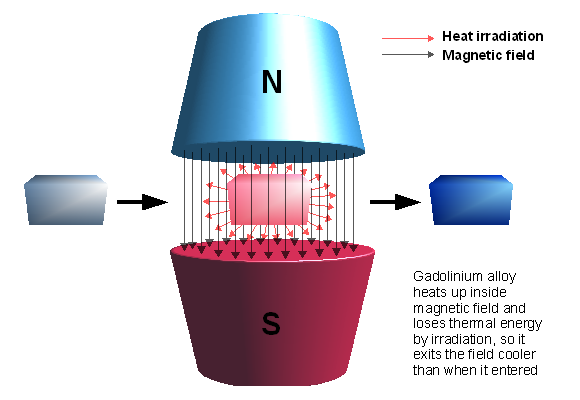 Photo by Mirsad Todorovac
Magnetic refrigeration isn’t exactly a new finding however. The concept of using magnetic fields for cooling has been around for quite sometime yet it wasn’t considered an effective alternative to modern refrigerators until recently. This is because its design relied on superconducting magnets that also had to be cooled, making it not cost or energy efficient. Now a team of GE engineers has developed a type of nickel-manganese alloy that can operate at room temperature to replace it. These new refrigerators are projected to be 20 percent more efficient than previous models and could be in homes within the next five years.
Photo by Mirsad Todorovac
Magnetic refrigeration isn’t exactly a new finding however. The concept of using magnetic fields for cooling has been around for quite sometime yet it wasn’t considered an effective alternative to modern refrigerators until recently. This is because its design relied on superconducting magnets that also had to be cooled, making it not cost or energy efficient. Now a team of GE engineers has developed a type of nickel-manganese alloy that can operate at room temperature to replace it. These new refrigerators are projected to be 20 percent more efficient than previous models and could be in homes within the next five years.
